
How to Tell If Your Garage Door Spring Is Broken: 7 Warning Signs
In This Article
- You Heard a Loud Bang from the Garage
- Your Garage Door Won't Open (or Is Extremely Heavy)
- The Door Opens Only 6 Inches Then Stops
- There's a Visible Gap in the Spring Coil
- The Door Closes Too Fast or Slams Shut
- The Top Section of the Door Bends When Opening
- Cables Are Hanging Loose or Look Frayed
- What to Do If You Spot These Signs
- How Much Does Spring Replacement Cost?
- Torsion vs. Extension Springs
- Frequently Asked Questions
Quick Summary
A broken garage door spring usually announces itself with a loud bang, a door that won't open, or visible gaps in the spring coil. Never try to open the door manually — call a professional. Same-day replacement is available across the Bay Area.
Something isn't right with your garage door. Maybe it won't budge when you press the remote. Maybe you heard a sound like a gunshot coming from the garage in the middle of the night. Maybe the door started rising and then just... stopped. Whatever brought you here, you're trying to figure out the same thing thousands of Bay Area homeowners search for every month: how to tell if your garage door spring is broken.
At Integrity Garage Doors & Gates, we've been answering this question in person since 2009 — more than 17 years of diagnosing broken springs across Hayward, Oakland, Fremont, San Jose, and the entire Bay Area. Springs are the single most common reason for a garage door that suddenly stops working. They're also the most misunderstood component of the system. Most homeowners don't think about their springs until something goes wrong, and when it does, the symptoms can be confusing.
This guide walks you through the seven telltale signs of a broken garage door spring, explains what's actually happening with the hardware, and tells you exactly what to do next. If you recognize even one of these signs, you almost certainly need a professional spring replacement.
1. You Heard a Loud Bang from the Garage
This is the most dramatic and recognizable symptom of a broken garage door spring. If you were home when it happened, you heard it — a single, sharp bang that sounds like a gunshot, a firecracker, or a car backfiring. Many homeowners tell us they initially thought someone was breaking into the garage, or that a heavy shelf had collapsed. The sound is unmistakable once you know what it is: a torsion spring snapping under full tension.
Here's what's happening mechanically. When your garage door is closed, the torsion springs above the door are wound tight and storing a tremendous amount of energy — enough to lift a 150- to 300-pound door smoothly and repeatedly. When the metal fatigues and the spring finally breaks, all of that stored energy releases in a fraction of a second. The spring unwinds violently on the torsion shaft, and the coils slam against each other. That collision is what produces the bang. If you have two springs, only one typically breaks at a time, but the force is still dramatic.
If you heard this sound and your door is now stuck in the closed position, you can be nearly certain the spring is broken. Don't try to force the door open with the opener — it will strain the motor and can damage the entire opener unit. Instead, call for same-day emergency service.
2. Your Garage Door Won't Open (or Is Extremely Heavy)
This is the sign that sends most homeowners searching the internet. You press the wall button or your remote, the opener motor hums and strains, and the door either doesn't move at all or lifts an inch or two and stops. Alternatively, you try to lift the door by hand and it feels impossibly heavy — like trying to deadlift a barbell you weren't expecting.
The reason is straightforward. Your garage door springs are responsible for counterbalancing the full weight of the door. The opener motor is only designed to move the door — to guide it along the tracks with a relatively small amount of force. It was never designed to lift 200 or more pounds on its own. When the spring breaks, the entire weight of the door sits on the opener's drive mechanism. Most residential openers produce about 10 to 15 pounds of lifting force on the chain or belt. That's nowhere near enough to overcome a 200-pound door with no spring assistance.
Try this: pull the red emergency release cord hanging from the opener's trolley to disconnect the door from the opener. Then try lifting the door from the bottom handle. If the door feels extremely heavy and won't stay up on its own at any height, your spring is broken. A properly working spring system makes the door feel almost weightless — you should be able to lift it with one hand and have it hold its position at the halfway point. If it slams to the floor the moment you let go, the spring has failed.
Important Safety Warning
Never attempt to replace a garage door spring yourself. Torsion springs are under 200 to 300 pounds of tension when fully wound. A slipped winding bar, a miscounted turn, or a loose set screw can release that energy in an instant — causing broken bones, deep lacerations, or worse. Emergency rooms across the country treat thousands of garage door spring injuries every year, some of them fatal. This is not a DIY project. Always call a trained, experienced technician for spring replacement.
3. The Door Opens Only 6 Inches Then Stops
Your opener activates, the door lifts a few inches off the ground — maybe four to six inches — and then the opener reverses and the door comes back down. This happens on repeat every time you try. The opener might flash its lights or click in a pattern, which is its way of telling you something is wrong.
What's happening here involves a safety feature built into every modern garage door opener. Openers have adjustable force limits that tell the motor how much resistance is acceptable before it should stop and reverse. When a spring breaks and the motor suddenly has to fight the door's full unassisted weight, it hits that force limit almost immediately. The opener interprets the excessive resistance as an obstruction — exactly as it would if the door hit a person or an object — and reverses to prevent damage or injury.
Some homeowners try to solve this by increasing the opener's force setting. Do not do this. Cranking up the force limit might get the door to open, but it puts extreme strain on the motor, the gear assembly, the chain or belt, and the door itself. You'll likely burn out the opener within days, turning a straightforward spring replacement into a spring replacement plus a far more expensive opener replacement. The correct fix is to replace the broken spring, not to override the safety system.
4. There's a Visible Gap in the Spring Coil
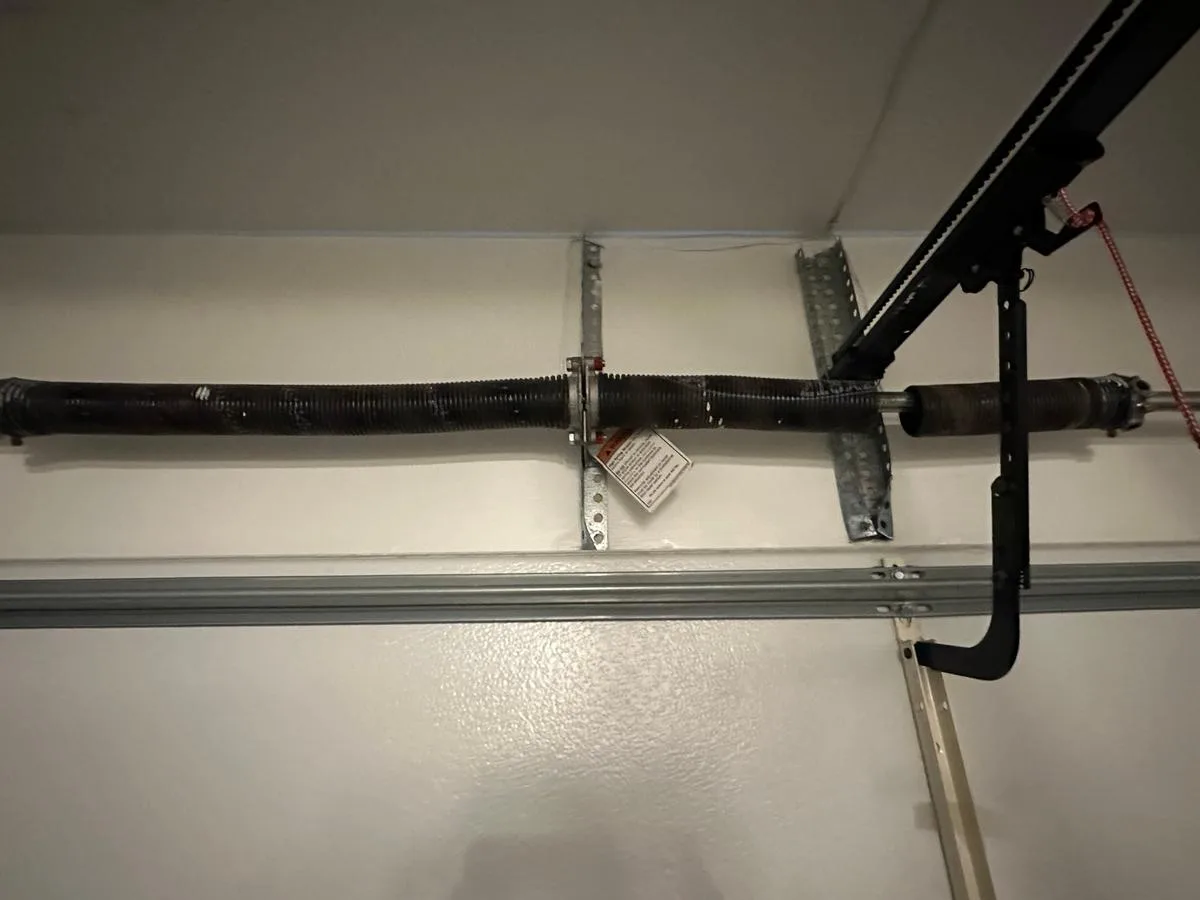
This is the easiest sign to confirm visually, though you need to know where to look. Stand inside your garage and look up at the area directly above the door opening. You'll see one or two tightly wound springs mounted on a horizontal metal shaft (the torsion tube). On a healthy spring, the coils are wound tightly together with no space between them when the door is closed.
When a spring breaks, it separates at the break point, creating a visible gap — usually one to three inches wide — in the middle of the coil. The two halves of the spring are still on the shaft, but there's a clear space where the metal fractured. Sometimes the gap is obvious from across the garage. Other times you need to look carefully, especially on a dark-painted spring against a dark ceiling. A flashlight helps.
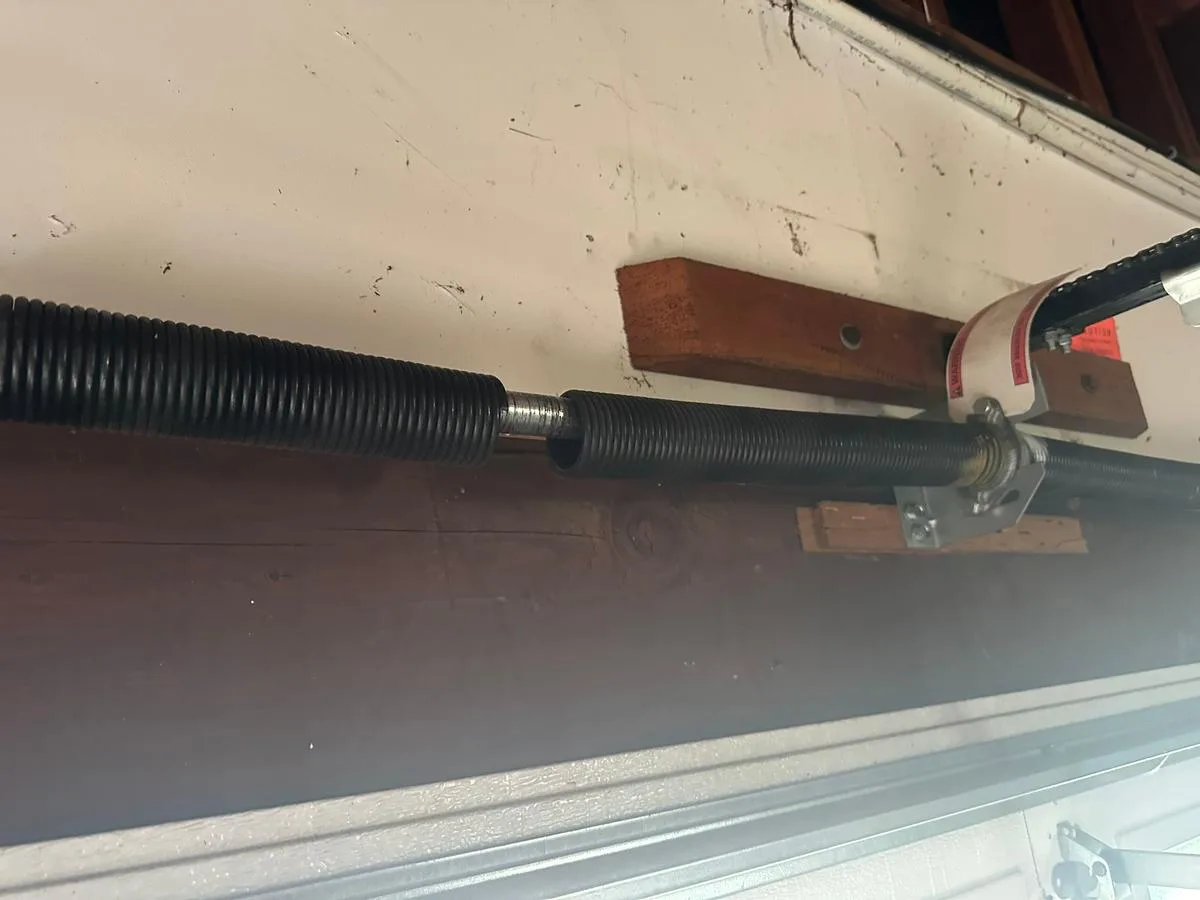
If you see this gap, the spring is definitively broken. There's no gray area. Even if the door still technically opens (which can happen on a two-spring system where only one has broken), the door is running on borrowed time. The remaining spring is now carrying double the load it was designed for, which means it's being stressed far beyond its rated capacity on every cycle. It will fail soon — often within days or weeks. Schedule a spring replacement immediately and avoid using the door until the repair is done.
5. The Door Closes Too Fast or Slams Shut
A properly balanced garage door moves at a controlled, steady speed — both when opening and when closing. The springs are what provide that control. When you close a door with working springs, the springs are winding up and absorbing energy, which creates a braking effect that keeps the door from accelerating under gravity. When the springs fail, that braking effect disappears.
A door that drops noticeably faster than it used to, or that slams the last foot or two instead of settling gently onto the floor, is telling you the springs have lost significant tension. This might mean one spring on a two-spring system has broken while the other is still partially functional. Or it could mean both springs are severely fatigued and nearing complete failure.
This symptom is a genuine safety hazard. A 200-pound door falling at uncontrolled speed can crush anything — or anyone — in its path. This is especially dangerous if you have children or pets who might be near the door when it's closing. If your door is dropping faster than normal, stop using it and call for professional repair right away.
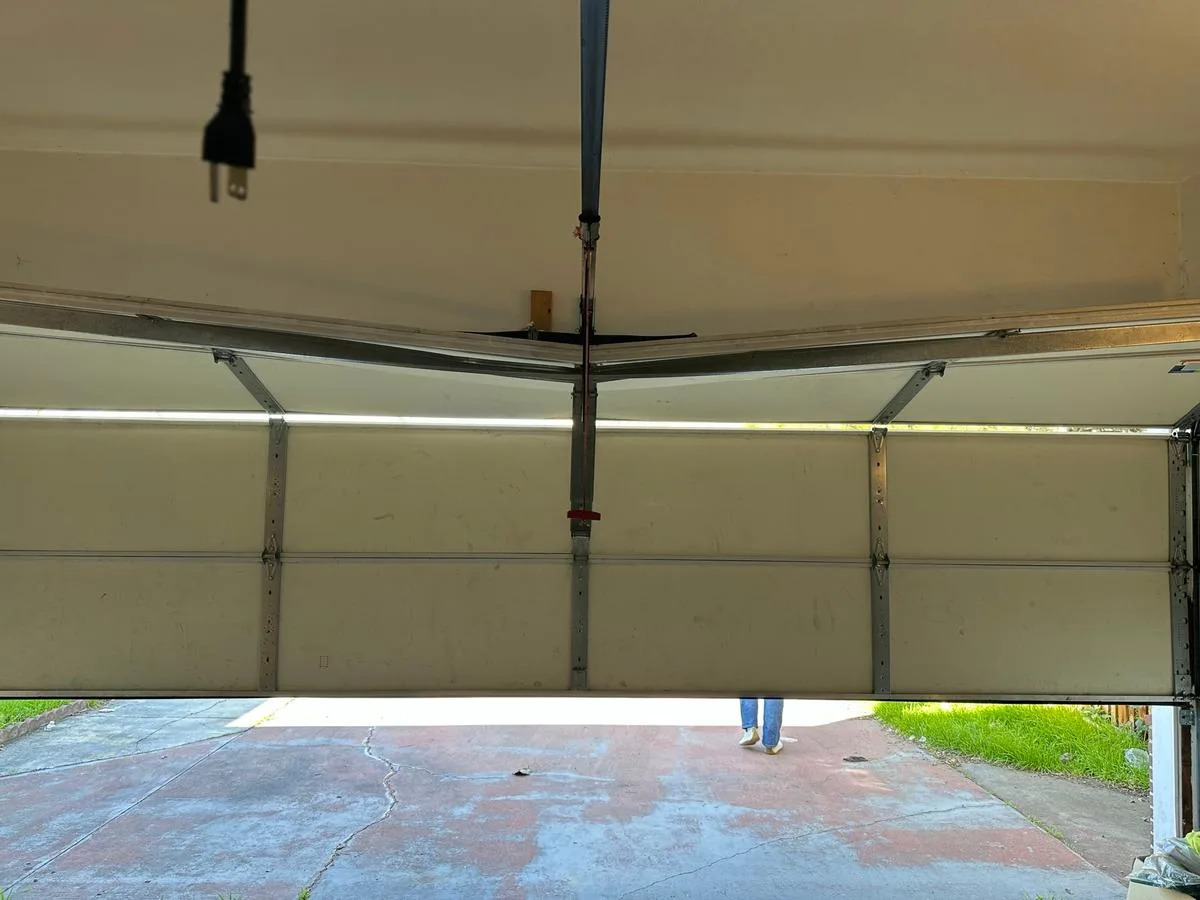
6. The Top Section of the Door Bends When Opening
This one catches homeowners off guard because they're looking at the door panels, not the springs. When the opener tries to lift a door with a broken spring, it pulls from a single attachment point — the bracket at the top of the door where the opener arm connects. With working springs, the lifting force is distributed across the entire door through the torsion shaft, cable drums, and cables. Without working springs, the opener is yanking the top of the door upward while the full weight of the lower panels hangs straight down.
The result is visible bending or bowing of the top panel. On steel doors, you'll see the top section flex and warp. On aluminum doors, it can actually crease or crack. The horizontal hinges between the top section and the second section take the brunt of the stress, and they can bend or tear out of the panel entirely.
If you notice the top section of your door flexing, bowing outward, or separating from the section below it when the opener activates, stop pressing the button immediately. Continuing to operate the door in this condition will permanently damage the top panel and potentially the second panel as well. Panel replacement is far more expensive than spring replacement — and if enough panels are damaged, you may be looking at a full door replacement instead of a simple spring repair.
7. Cables Are Hanging Loose or Look Frayed
The lifting cables on a garage door run from the cable drums at each end of the torsion shaft, down to brackets at the bottom corners of the door. When the springs are intact and under tension, these cables are held taut. They wrap neatly around the cable drums as the door opens, and they unwind smoothly as the door closes. You shouldn't see any slack in them during normal operation.
When a torsion spring breaks, the tension that keeps the cables tight disappears. The cables go slack instantly. You'll see them hanging in loose loops beside the door, drooping off the drum, or tangled around the torsion shaft. Sometimes a loose cable jumps off the drum entirely and wraps around the shaft, which creates a dangerous condition — the cable can fray, kink, or snap when the door moves.
Inspect the cables visually without touching them. If you see slack cables, cables hanging loose on one or both sides of the door, or cable that shows signs of fraying (individual wire strands poking out or unraveling), the spring system has failed. Do not try to re-tension the cables yourself or rewind them on the drum — this involves the spring system and carries the same injury risks as spring replacement. Call a professional who can replace the springs, re-cable the drums, and inspect the cables for damage that would require cable replacement as well.
What to Do If You Spot These Signs
If you've identified one or more of these broken garage door spring symptoms, here's what to do — and what not to do:
Stop using the opener immediately. Every time you press the button on a door with a broken spring, you risk burning out the opener motor, damaging panels, snapping cables, or bending tracks. The opener was never designed to lift the door's full weight alone.
Do not try to repair or replace the spring yourself. We cannot stress this enough. Garage door spring replacement is one of the most dangerous home repairs that exists. The springs, the winding bars, and the torsion shaft are all under extreme force. Leave this to a trained technician with the right tools and experience.
If you need to get your car out, use the emergency release. Pull the red emergency release cord (it hangs from the opener trolley on the rail) to disconnect the door from the opener. With two adults, you can lift the door manually. Be prepared — it will be very heavy. Prop it open with a sturdy object like a 2x4, because it will slam shut on its own. Once your car is out, lower the door carefully and lock it until the repair is done.
Call a professional for same-day service. Broken springs are the most common garage door emergency, and reputable companies stock standard spring sizes on their trucks for exactly this reason. At Integrity Garage Doors & Gates, we offer same-day emergency service across the Bay Area. Call us at (888) 485-6995 and we'll get a technician to you as quickly as possible.
Need a spring replaced today? Call Integrity Garage Doors & Gates at (888) 485-6995 for same-day service, or request a free estimate online. We serve Hayward, Oakland, Fremont, San Jose, and the entire Bay Area.
How Much Does Spring Replacement Cost?
At Integrity Garage Doors & Gates, garage door spring replacement is competitively priced and includes the spring itself, all mounting hardware (bearing plates, center bracket, set screws), professional installation and precision winding, a full door balance adjustment, a complete safety inspection, lubrication of all moving parts, and our parts and labor warranty. Call (888) 485-6995 or request a free quote for current pricing.
We always recommend replacing both springs at the same time, even if only one has broken. Both springs were installed together and have the same number of cycles on them. When one fails, the other is at the end of its service life too. Replacing just the broken spring saves a small amount today but almost guarantees a second service call — and a second trip charge — within weeks. Over 17 years, we've seen this play out hundreds of times. Replacing the pair is the smarter investment.
Pricing may vary for oversized doors, commercial doors, or doors that need a conversion from extension springs to torsion springs. We always provide an exact, written quote before starting any work. If you don't want to proceed, there's no charge for the inspection. Get a free estimate here.
Torsion vs. Extension Springs: A Quick Comparison
Not all garage door springs are the same. There are two types used on residential doors, and the one you have affects everything from lifespan to safety to replacement cost.
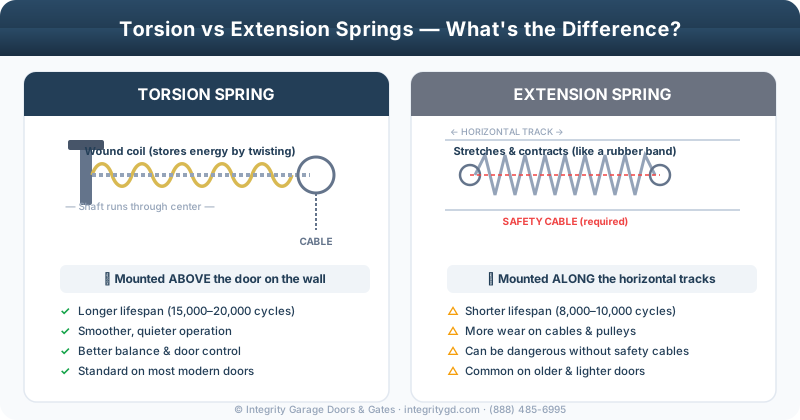
Torsion springs mount on a horizontal shaft directly above the door opening. They use torque — twisting force — to lift the door. They provide smooth, even lifting force, last longer, operate more quietly, and fail more safely (the spring stays on the shaft when it breaks). Torsion springs are the industry standard on all modern garage door installations.
Extension springs run along the horizontal tracks on each side of the door. They stretch to store energy when the door is closed, then contract to help lift the door open. Extension springs are the older technology. They wear out faster, distribute force less evenly, and when they break, they can fly across the garage at high speed. Safety cables running through the center of the spring are required by code, but the failure mode is still more dangerous than a torsion spring break.
If your home currently has extension springs, we strongly recommend upgrading to a torsion system when replacement time comes. The upfront cost is slightly higher, but the safety, longevity, and smoother operation make it worthwhile. You can learn more about the differences on our FAQ page, which includes detailed comparison tables for springs, openers, and more.
Frequently Asked Questions
Can I open my garage door with a broken spring?
You can, but it requires effort and caution. Pull the red emergency release cord to disconnect the opener, then have two adults lift the door from the bottom. It will be very heavy — 150 to 300 pounds depending on the door size and material. You must prop it open with something sturdy because it will slam shut the moment you let go. Do not try to open it with the electric opener; you'll likely burn out the motor or damage the door panels.
How long do garage door springs last?
Standard springs are rated for about 10,000 cycles (one open + one close = one cycle). At four cycles per day, that's roughly 7 years. High-cycle springs rated for 25,000 or 50,000 cycles can last 15 to 30 years. Factors that shorten spring life include rust, lack of lubrication, coastal humidity (common throughout the Bay Area), and frequent daily use. Regular maintenance — specifically lubricating the springs with silicone spray twice a year — can extend their lifespan.
Is a broken garage door spring dangerous?
Yes, in two ways. First, a door with a broken spring has no counterbalance, meaning it can drop unexpectedly and crush anything beneath it. Second, the spring replacement process itself is dangerous for anyone without professional training. Torsion springs store 200 to 300 pounds of force, and that energy can cause severe injuries if released uncontrollably. Never attempt a DIY spring replacement. Call a licensed professional instead.
How much does it cost to replace a garage door spring?
At Integrity Garage Doors & Gates, spring replacement includes the spring, hardware, labor, balance adjustment, safety inspection, and warranty. Our pricing is competitive, and most homeowners replace both springs at once to avoid a repeat service call when the second one fails shortly after. Contact us for a free estimate specific to your door.
How can I tell if I have a torsion spring or an extension spring?
Look above the garage door opening from inside the garage. If you see one or two tightly wound coils on a horizontal metal shaft running across the top of the opening, those are torsion springs. If instead you see long, thinner springs running along each horizontal track (parallel to the ceiling on both sides of the door), those are extension springs. Most doors installed in the last 15 to 20 years use torsion springs. If you're unsure, send us a photo and we'll identify your spring type for free.
Spring Replacement Near You
We offer same-day spring replacement across the Bay Area. Visit your local service page for details:
Hayward · Oakland · Fremont · San Jose · Berkeley · Concord · San Francisco · All locations →
Related Articles
Serving the Entire Bay Area
Integrity Garage Doors & Gates provides expert service across the San Francisco Bay Area. Find your local service area:
Hayward • Oakland • Fremont • San Jose • San Francisco • Concord • Walnut Creek • Dublin • Pleasanton • Castro Valley • San Leandro • Danville • San Ramon • Palo Alto • Mountain View • Berkeley • San Mateo • Redwood City • Livermore • All Locations →
Think Your Spring Is Broken? We'll Confirm It for Free.
Call Integrity Garage Doors & Gates for a free inspection and honest diagnosis. If the spring is broken, we stock the most common sizes on our trucks and can replace it the same day — with upfront pricing and a warranty you can count on.