
Garage Door Off Track: Repair Costs & How to Fix It
If your garage door came off track, do not touch it. Repair typically costs $150–$500 in 2026 depending on the cause. This complete guide explains what makes a garage door jump the track, exactly what to do right now, when to call a professional, and a full Bay Area price breakdown.
In This Article
- What it means when a door goes off track
- Types of off-track problems
- 8 causes of an off-track garage door
- Step-by-step assessment guide
- Why an off-track door is so dangerous
- What to do immediately (step-by-step)
- What NOT to do
- DIY vs. professional repair
- When to call a professional
- Professional repair process
- Cost expectations in the Bay Area
- How to prevent it from happening again
- Frequently asked questions
Quick Summary
If your garage door has come off the track, stop using it immediately. Do not try to force it back on yourself. Disconnect the opener, keep everyone away from the door, and call a professional. The repair typically costs $125 to $500 in the Bay Area depending on the root cause.
What It Means When a Garage Door Goes Off Track
Your garage door rides on a pair of metal tracks — vertical sections on each side of the opening that curve into horizontal sections running along the ceiling. Steel or nylon rollers attached to the door panels sit inside these tracks and guide the door as it opens and closes. When one or more rollers pop out of the track channel, the door "derails." It may hang crookedly, jam partway open, or slam down at an angle.
This is not a cosmetic issue. A standard residential garage door weighs between 150 and 400 pounds. When it is off track, that weight is no longer being controlled by the spring and cable system the way it should be. The door can shift, drop, or fall without warning. We see off-track calls regularly across our Bay Area service area — from Hayward and Oakland to San Jose and San Francisco — and in nearly every case the homeowner made the right decision by not trying to muscle the door back into place.
Whether your garage door came off track during normal operation, after a power outage, or because of an impact, the steps you take in the next few minutes matter. This guide covers everything you need to know: what caused it, how to stay safe, whether you should attempt a DIY fix (spoiler: you should not), what professional repair involves, and how much it costs.
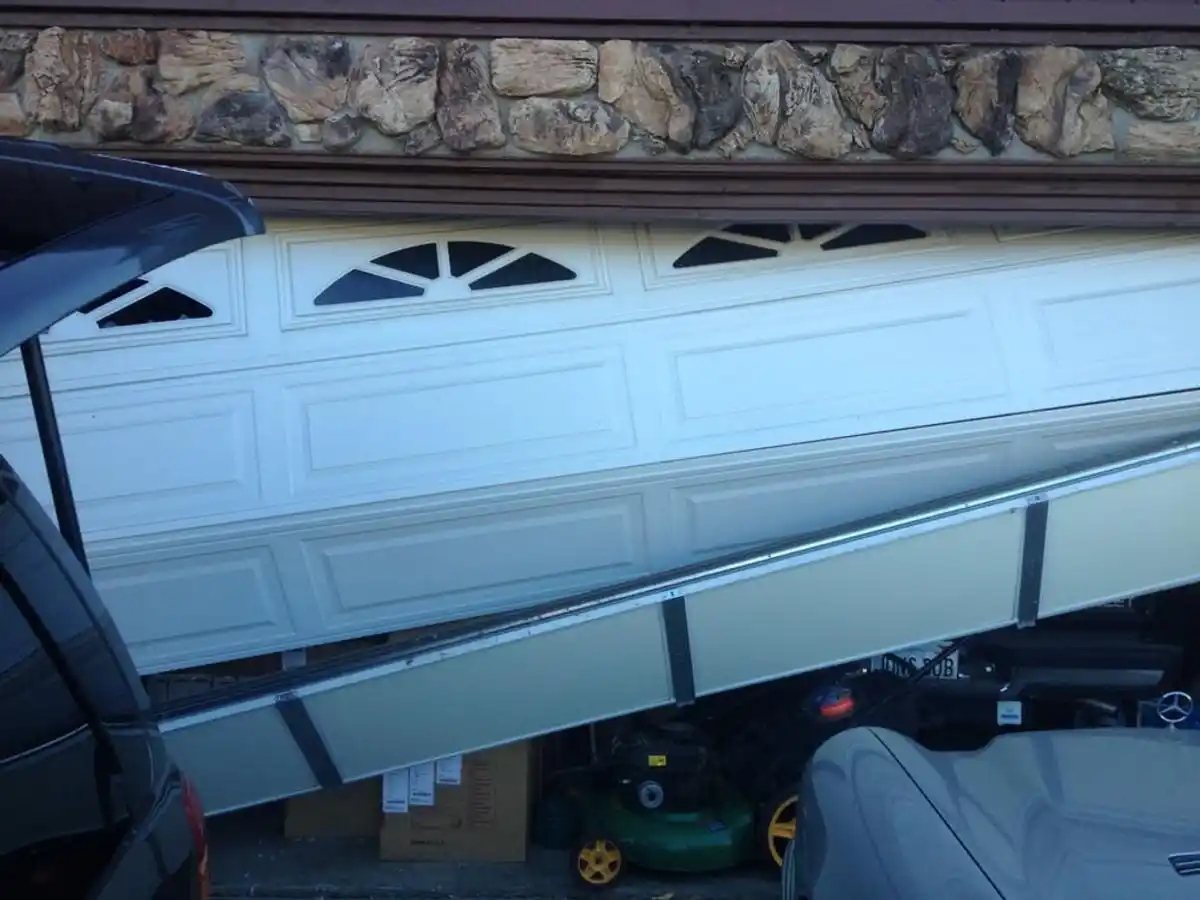
Types of Garage Door Off-Track Problems
Not all off-track situations are the same. Understanding which type of derailment you are dealing with helps a technician prepare the right tools and parts before arriving. Here are the most common types we see at our Castro Valley headquarters and across the Bay Area.
Garage Door Roller Off Track
This is the most common type. One or more steel or nylon rollers have popped out of the track channel, usually at the curved section where the vertical track transitions to the horizontal ceiling track. A garage door roller off track situation often means the rollers are worn, the track is slightly bent at the curve, or an obstruction forced the roller out. You will typically see the roller sitting outside the track with the door hanging at an angle. If only one or two rollers are displaced and no other damage occurred, this is usually the simplest and least expensive off-track repair.
Garage Door Cable Off Track
When a lift cable snaps or jumps off the cable drum, the side of the door it supports drops suddenly. This violent, uneven movement pulls multiple rollers out of the tracks at once. A garage door cable off track scenario is more serious because the cable itself must be replaced in addition to re-seating the rollers. You will usually notice frayed or broken cable hanging loose near the bottom bracket, and the door will be visibly tilted with one side significantly lower than the other. Cable-related derailments account for roughly 30% of the off-track calls we receive.
Door Jumped Completely Off Both Tracks
In severe cases — usually from a vehicle impact or a catastrophic spring failure — the door can come off both tracks entirely. The door may be hanging at a steep angle, sitting on the garage floor at an odd position, or leaning against one wall. This is the most dangerous scenario because the door has no support system whatsoever. It is held up only by friction and whatever mechanical parts have not yet failed. Do not go near a door that has completely left both tracks. Call (888) 485-6995 for emergency service immediately.
Bottom Panel Off Track Only
Sometimes only the bottom panel derails while the upper panels remain seated. This typically happens when the bottom bracket or roller is damaged, when a vehicle bumps the door while it is closed, or when debris gets caught under the door as it closes. The door may appear to close normally from a distance but have a visible gap or tilt at the bottom. While this looks less severe, it still puts abnormal stress on the hinges, cables, and adjacent rollers, and will get worse with continued use.
8 Causes of an Off-Track Garage Door
Understanding why your garage door came off track is the first step toward a lasting repair. Here are the eight most common causes we encounter on service calls across the Bay Area.
1. Broken Lift Cable
The lift cables connect the torsion springs to the bottom brackets on each side of the door. They bear the full counterbalance force — often 150 pounds or more per cable. When a cable snaps or jumps off the drum, one side of the door instantly loses its support and drops while the other side stays up. This sudden, uneven load forces the rollers out of the track almost immediately. A cable replacement is almost always needed alongside the off-track repair itself. Regular spring and cable inspections can help catch fraying before it leads to a complete failure.
2. Worn-Out Rollers
Garage door rollers have a limited lifespan. Standard steel rollers last about five to seven years with regular use, while nylon rollers can last ten to fifteen years. As the bearings wear out, the rollers develop wobble and play, which means they no longer fit snugly in the track channel. A worn roller can slip out during normal operation, especially on the curved section where the vertical track transitions to the horizontal ceiling track. If your door has been increasingly noisy, jerky, or hesitant lately, that is a warning sign that the rollers are degrading and a derailment could be next.
3. Obstruction in the Track
A small object wedged in the track — a bolt, a pebble, a piece of weatherstripping that has pulled loose, or even a buildup of hardened grease and dirt — can catch a roller and force it out of the channel as the door moves past. This is especially common after a home project where tools or hardware end up near the tracks, or in garages where items are stored close to the door's path. The good news is that obstruction-related derailments usually do not cause secondary damage to the track itself, making them one of the simpler off-track repairs.
4. Bent Track
Garage door tracks are made from galvanized steel, but they are not indestructible. Over years of use, tracks can develop bends or warps — especially near the bottom where they are most exposed. Even a slight bend narrows the channel enough that a roller can pop out during operation. Sometimes the bend is subtle enough that the door operates with a slight grinding noise for weeks or months before it finally derails. A technician will either straighten the bent section with specialized track tools or replace the affected track segment entirely.
5. Broken Torsion Spring
Your garage door's torsion spring (or springs, on heavier doors) provides the counterbalance force that makes the door light enough to lift. When a spring breaks, the door becomes dead weight — but more critically, the sudden release of tension on one side can cause the door to jerk violently and pop rollers out of the tracks. A broken spring is one of the most common reasons we see off-track doors. If you heard a loud bang from the garage followed by the door not working properly, a broken spring is the likely culprit. Learn how to tell if your garage door spring is broken.
6. Impact Damage
Backing into a garage door with a vehicle is more common than most people want to admit. Even a low-speed bump can bend the bottom panel, shift the track brackets, or pop rollers loose. We also see impact damage from items falling against the door from inside the garage — a bicycle leaning against it, a heavy shelf tipping over, or kids throwing a ball. In the Bay Area, winter storms occasionally blow debris into partially open doors as well. If the tracks themselves are bent from the impact, they will need to be straightened or replaced as part of the repair.
7. Loose Track Brackets
The vertical and horizontal tracks are secured to the wall and ceiling by metal brackets and lag bolts. Over time, the vibration from daily door operation can loosen these fasteners. When a bracket shifts even a fraction of an inch, it changes the track alignment enough to let a roller escape the channel. This is a particularly sneaky cause because everything looks normal at a glance — the looseness only becomes apparent when a technician checks the bracket torque during inspection. Homes in earthquake-prone areas of the Bay Area are especially susceptible to bracket loosening after seismic activity.
8. Poor Original Installation
Not every garage door installation is done correctly. If the tracks were not perfectly plumb (vertical) and level (horizontal), or if the track spacing does not match the door's roller stem length, the door can be prone to derailing from day one. We occasionally see doors installed with the wrong track radius for the door's weight, or with tracks that are not properly shimmed. If your door has come off track more than once despite no obvious damage, a faulty installation may be the underlying issue. A professional can assess the track geometry and correct any installation errors.
How to Assess What Went Wrong: A Step-by-Step Guide
Before a technician arrives, you can safely gather information about your off-track situation from a distance. This helps the repair crew bring the right parts and give you an accurate estimate over the phone. Stand at least four feet away from the door at all times during this visual inspection — never touch the door, tracks, cables, or springs.
Step 1: Look at the Door's Position
The way the door is sitting tells a trained eye exactly what failed. If the door is tilted with one side lower than the other, a cable likely snapped or jumped off the drum on the lower side. If the door is jammed partway open at a slight angle, one or more rollers have popped out of the track, usually at the curved transition section. If the door is sitting on the floor at an odd position or leaning against one wall, both tracks have been compromised — likely from a vehicle impact or catastrophic spring failure. If only the bottom panel appears misaligned while the upper panels look normal, the bottom roller or bracket is the likely culprit.
Step 2: Inspect the Tracks Visually
Look at both vertical tracks from a safe distance. Are they straight and parallel, or can you see a visible bend, dent, or outward bow in either one? Check where the vertical track curves into the horizontal ceiling track — this transition area is where rollers most commonly escape. Look for any objects lodged in the track channel. If a track bracket appears loose or pulled away from the wall, that is likely the root cause. Report what you see to your technician when you call — it helps us arrive prepared with the right replacement parts.
Step 3: Check the Cables
The lift cables run from the cable drums at the top of the door down to the bottom brackets on each side. From a safe distance, look at both cables. A healthy cable appears taut and neatly wound on the drum. If you see a cable that is hanging loose, visibly frayed, or coiled on the floor, that cable has either snapped or jumped off its drum. If both cables appear intact and taut, the derailment was likely caused by a roller, track, or bracket issue rather than a cable failure. Never touch a cable — even a slack cable can be under residual spring tension.
Step 4: Listen for Spring Clues
If you heard a loud bang — like a gunshot or a car backfiring — from the garage before the door went off track, a torsion spring almost certainly broke. Look at the spring bar mounted horizontally above the door. A broken spring will have a visible gap in the coil, usually near the center. If both halves of the spring are still on the bar but separated by a gap, that confirms the break. A broken spring means the technician needs to bring a replacement spring sized for your door's weight, so mention this when you call.
Step 5: Note Any Impact Evidence
If the bottom panel has a dent, crease, or visible deformation, a vehicle or heavy object likely struck the door. Impact damage often bends both the panel and the adjacent track simultaneously. Check if the track mounting brackets near the impact point have shifted or if the wall anchors are pulled out. Impact-related derailments tend to require more parts (track sections, panels, rollers) than wear-related failures, so letting the technician know upfront helps with accurate quoting.
Once you have completed this visual assessment, call (888) 485-6995 and describe what you see. Our dispatchers will relay the details to the technician so they arrive with the right parts for a single-visit repair. If you are in San Leandro, Castro Valley, Union City, or anywhere in the Bay Area, we can typically be there within one to two hours for emergency calls.
Why an Off-Track Garage Door Is Extremely Dangerous
This is not an exaggeration: an off-track garage door is one of the most dangerous situations a homeowner can face around the house. Here is why you need to take it seriously.
The Weight Factor
A single-car garage door typically weighs between 130 and 200 pounds. A standard two-car garage door weighs between 200 and 350 pounds. Insulated or custom wood doors can exceed 400 pounds. When the door is on track and properly counterbalanced by the spring system, you barely notice the weight — the door feels light and moves easily. But when the door is off track, the spring counterbalance is no longer working correctly. That means all of that weight can shift or drop without warning. A 300-pound steel door falling even a few inches can crush bones, sever fingers, or pin a person to the ground.
Spring Tension Is Lethal
The torsion spring mounted above the door stores an enormous amount of energy — enough to lift the full weight of the door thousands of times. When the door goes off track, the spring tension becomes unpredictable. A cable can snap. A spring can unwind violently. The stored energy in a torsion spring for a two-car door is roughly equivalent to the force of a car hitting a wall at 20 mph. There is a reason the Consumer Product Safety Commission reports that garage doors cause roughly 30,000 injuries per year in the United States, many involving springs and cables.
The Door Can Fall at Any Moment
When a door is off track, it is held up by friction, by whatever rollers are still seated, and by the cables — all in ways they were not designed for. A gust of wind, a slight vibration, or even temperature changes causing the metal to expand or contract can be enough to shift the door and cause it to come crashing down. Never assume the door is "stable enough" to walk under or work near. Treat it like it could fall at any second, because it can.
This Is NOT a DIY Job
We understand the temptation. The door is stuck, you are in a hurry, and the fix looks like it should be simple — just pop the rollers back in, right? Wrong. Without the proper tools to safely manage the spring tension, without clamps to secure the door against unexpected movement, and without the experience to identify whether cables or springs are compromised, you are putting yourself in serious danger. We have been called to homes where a DIY attempt turned a $200 repair into a $1,500 repair because the homeowner bent the tracks, snapped a cable, or cracked a panel trying to force the door. More importantly, we have seen close calls where someone narrowly avoided the door falling on them. Please do not risk it.
What to Do Immediately When Your Garage Door Goes Off Track
If your garage door has just gone off track, follow these steps in order:
- Stop using the door immediately. Do not press the wall button or remote. Do not try to manually push or pull the door. Any movement can make the situation worse and more dangerous.
- Disconnect the garage door opener. Pull the red emergency release cord that hangs from the opener's trolley. This disconnects the opener from the door so no one can accidentally activate it with a remote, wall button, or smart home app.
- Keep everyone away from the door. Move people, pets, and vehicles away from the immediate area. Do not stand under the door or in its path. If cars are parked inside, leave them there for now unless you can safely exit through a side door.
- Do not try to force the door back on track. Resist the urge to use a crowbar, hammer, or brute force. You cannot safely manage the spring tension and door weight without proper tools and training.
- Secure the area if the door is stuck open. If the door is jammed partway open and you are concerned about security or weather, place a visible barrier (trash cans, sawhorses) across the opening. Do not attempt to lower the door.
- Call a professional. Contact a licensed garage door technician for repair. If it is after hours or the situation feels urgent, ask for emergency service — we offer 24/7 availability across the Bay Area. Call (888) 485-6995.
What NOT to Do When Your Garage Door Is Off Track
This is the most important section of this article. The following mistakes can turn a straightforward repair into a much more expensive problem — or cause a serious injury.
- Do not try to operate the door with the opener. The motor will try to force the door along a path it can no longer follow, which can bend the tracks further, snap cables, tear roller brackets out of the panels, or strip the opener's gears. This often doubles the repair cost.
- Do not try to manually push or pull the door back on track. Without proper tools and knowledge of the spring tension involved, you risk the door dropping on you. A standard two-car garage door weighs around 250 pounds — more than enough to cause a fatal crush injury.
- Do not try to remove rollers, cables, or brackets. These components are under significant spring tension. Releasing that tension incorrectly can cause the spring or cable to whip violently. Torsion springs store enough energy to cause fatal injuries.
- Do not stand or walk under the door. Until the door is professionally secured, treat it like it could fall at any moment, because it can. This applies to everyone — family members, pets, neighbors who come to "help."
- Do not try to use the door "just one more time." We hear this constantly. The door looks like it is mostly on track, so the homeowner tries to open or close it one more time. This almost always makes the damage worse and can cause the door to fully derail and fall.
- Do not watch YouTube tutorials and attempt a fix. Off-track repair involves working with components under extreme tension. The risk-to-reward ratio of a DIY attempt is not worth it. The repair typically costs $150 to $350 — far less than an emergency room visit.
What you should do: Pull the red emergency release cord to disconnect the opener from the door. This prevents anyone from accidentally triggering the motor with a remote. Then call a professional. If the door is stuck in an open position and you are concerned about security, place a visible barrier and contact us for emergency service.
DIY vs. Professional Garage Door Off-Track Repair
Can you fix a garage door off track yourself? The short answer is no, and here is a detailed breakdown of why this is one repair where calling a professional is not optional — it is a safety requirement.
Why DIY Off-Track Repair Is Dangerous
The internet is full of tutorials showing how to fix a garage door off track with basic tools. What those videos rarely mention is the lethal spring tension involved. A standard torsion spring for a two-car garage door stores between 15,000 and 30,000 foot-pounds of rotational energy. That is roughly equivalent to the energy of a .357 magnum bullet. If you are working near the spring, cable drums, or lift cables when something shifts unexpectedly, the result can be catastrophic.
Professional technicians use specialized winding bars (never screwdrivers or rebar), C-clamps to lock the door in place, and track-spreading tools designed specifically for re-seating rollers. They also know how to read the spring tension visually and through feel, identifying whether it is safe to proceed or whether the tension must be released first. These are skills that take years to develop — not something a YouTube video can teach in ten minutes.
The Real Cost of a DIY Attempt Gone Wrong
We have responded to dozens of calls where a homeowner attempted to fix a garage door that came off track and made the situation significantly worse. The most common outcomes of failed DIY attempts include:
- Bent tracks: Using a crowbar or hammer to force rollers back in often bends the track, turning a $200 repair into a $400-$500 track replacement.
- Cracked panels: Trying to lift or pry the door puts concentrated force on panel joints, cracking fiberglass inserts or bending steel panels. Panel replacement costs $200-$500 per panel.
- Snapped cables: Manipulating the door without managing spring tension can cause a cable to snap, adding $150-$250 to the repair.
- Stripped opener gears: Running the opener to "help" move the door while rollers are out strips the nylon drive gears, requiring a $150-$300 opener repair.
- Personal injury: The most serious outcome. Emergency room visits for garage door injuries average $3,000-$8,000, and severe crush injuries can be life-altering.
The professional repair for a straightforward off-track situation costs $150-$350. Compared to the potential consequences of a DIY attempt, hiring a licensed technician from a company like Integrity Garage Doors & Gates is the clear choice.
The One Thing You Can Safely Do Yourself
The only safe DIY action when your garage door is off track is disconnecting the opener by pulling the red emergency release cord. This is specifically designed to be operated by homeowners. Pull it straight down to disengage the trolley from the opener chain or belt. This prevents anyone from accidentally activating the motor. After that, call a professional for the actual repair.
When to Call a Professional for an Off-Track Garage Door
Every off-track garage door needs professional repair, but some situations are more urgent than others. Here is how to assess the urgency of your situation.
Call for Emergency Service (Same-Hour Response) If:
- The door is hanging at a severe angle and looks like it could fall
- You can hear cables creaking or springs making unusual sounds
- The door is stuck wide open and you cannot secure your home
- A vehicle is trapped inside the garage and you need to get it out
- The door fell or dropped suddenly and there may be damage to vehicles or property underneath
For emergencies, call (888) 485-6995 — we provide 24/7 emergency service across the entire Bay Area, including Hayward, Oakland, Fremont, San Jose, and San Francisco.
Call for Same-Day or Next-Day Service If:
- The door is off track but in a closed or mostly closed position
- The door is not visibly at risk of falling
- You have disconnected the opener and secured the area
- You can use another entrance to your home in the meantime
In these cases, schedule a repair appointment at your convenience. We will come out, diagnose the root cause, give you a written estimate, and complete the repair — usually in a single visit.
What a Professional Off-Track Repair Involves
When one of our technicians arrives for an off-track service call, the process typically follows these steps:
- Full inspection and assessment: Before touching anything, we thoroughly inspect the door, tracks, rollers, cables, springs, brackets, and panels to determine exactly what caused the derailment and whether any secondary damage occurred. This step is critical — fixing the symptom without diagnosing the root cause means the door will come off track again.
- Securing the door: We use locking pliers or C-clamps on the tracks to prevent the door from moving while we work. If the springs are compromised, we use winding bars to safely manage the torsion before proceeding. Safety is always the first priority.
- Releasing tension as needed: If a broken spring or cable caused the derailment, we safely release the remaining spring tension using proper winding bars. This is one of the most dangerous steps in the process and the primary reason this is not a DIY repair.
- Repositioning rollers in the track: Using pry bars and specialized track-spreading tools, we carefully guide each displaced roller back into the track channel. If the track is bent, we straighten it using track pliers or replace the damaged section entirely.
- Root-cause repair: If a broken cable, worn roller, bent bracket, or failed spring caused the derailment, we replace those parts on the spot. Putting the door back on track without fixing the underlying cause guarantees it will happen again. We carry common replacement parts — cables, rollers, brackets, and track sections — on every truck.
- Lubrication and adjustment: We lubricate all rollers, hinges, and the torsion spring with a garage door-specific lubricant. We also check and adjust the track alignment, ensuring both tracks are perfectly plumb, level, and properly spaced.
- Full testing: We run the door through several complete open-close cycles to confirm smooth, balanced operation. We check the spring balance (the door should stay in place when opened halfway and released), test the auto-reverse safety sensors, and verify the opener is properly reconnected and functioning.
Most off-track repairs are completed in a single visit lasting 45 to 90 minutes. If the derailment caused secondary damage — cracked panels, multiple bent track sections, or a broken spring that also needs replacement — the visit may take up to two hours. We rarely need a second trip because we stock the most commonly needed parts on our service trucks.
Off-Track Garage Door Repair Cost in the Bay Area
Off-track repair pricing depends on the root cause, the extent of any additional damage, and whether replacement parts are needed. Here are the typical cost ranges we see in the San Francisco Bay Area as of 2026:
Simple Realignment — $150 to $250
If the rollers simply popped out of the track due to a minor obstruction or a one-time incident, and no parts are damaged, the repair involves repositioning the rollers, checking the track alignment, and testing. This is the least expensive scenario and the most common for newer doors in good condition.
Realignment Plus Roller Replacement — $200 to $350
If worn-out rollers caused the derailment, we replace all the rollers (not just the ones that came off track, since the others are likely in similar condition). A full set of nylon rollers for a standard two-car door costs between $80 and $150 for parts, plus the labor to re-track and install.
Realignment Plus Cable Replacement — $225 to $400
When a snapped cable caused the off-track condition, we replace both cables (they wear at the same rate, so if one broke, the other is likely close behind). Cable replacement requires carefully managing the spring tension, which adds time and complexity to the repair.
Realignment Plus Track Repair or Replacement — $250 to $500+
Bent or damaged tracks may need to be straightened with specialized tools or replaced entirely. If the track damage is extensive — for example, if a vehicle impact bent both the track and the door panel — the repair cost can be higher. In cases where panel replacement is also needed, the total can reach $500 to $800 depending on the door model.
Off-Track Plus Broken Spring — $300 to $550
If a broken torsion spring caused the door to go off track, the spring replacement is the primary repair, with the off-track realignment included. Spring replacement is one of our most common service calls and we carry springs for most residential door sizes on our trucks.
We always provide a firm, written quote before beginning any work — no surprises on the invoice. The estimate is free, and there is no obligation if you decide not to proceed. For a detailed breakdown of general repair costs, see our Bay Area garage door repair cost guide.
Free Estimates, No Obligation
Not sure what is wrong with your door? Call us at (888) 485-6995 or request a free estimate online. We will diagnose the issue and give you a firm price before we start any work. Check our current specials and coupons for additional savings on your repair.
How to Prevent Your Garage Door From Going Off Track
An off-track garage door is almost always preventable. A few straightforward maintenance habits can dramatically reduce the chance of it happening:
Visual Track Inspection (Monthly)
Take 60 seconds once a month to look at both tracks from top to bottom. You are looking for debris in the channel, loose bolts or screws on the brackets, signs of rust, and any areas where the track appears bent, dented, or misaligned. Catching a developing problem early is far cheaper than dealing with a full derailment.
Listen for Warning Signs
Pay attention to how your door sounds during operation. Grinding, scraping, popping, or squealing sounds often indicate roller or track issues that are developing. A door that hesitates or jerks at certain points during its travel may have a roller that is about to fail. If you notice these sounds, schedule a professional inspection before the door goes off track.
Lubrication Schedule (Every 6 Months)
Lubricate the rollers, hinges, and torsion spring with a silicone-based or lithium-based garage door lubricant twice a year. Do not use WD-40 — it is a solvent, not a lubricant, and it can actually strip existing lubrication from your rollers. Proper lubrication reduces friction, extends roller life, and helps the door travel smoothly in the tracks. Our complete maintenance checklist walks you through the full process.
Keep the Tracks Clean
Wipe down the inside of the tracks with a damp cloth periodically to remove dirt, grease buildup, and debris. Do not lubricate the tracks themselves — you want the rollers to grip, not slide. Keeping the track channel clear ensures the rollers have a clean path to follow.
Annual Professional Inspection
Have a licensed technician inspect the rollers, cables, springs, tracks, and brackets at least once a year. They can identify worn rollers before they fail, check bracket torque, test spring balance, and spot early signs of cable fraying. An annual tune-up typically costs $80 to $120 and can prevent repairs that cost several times that amount.
Replace Rollers Proactively
If your rollers are more than five to seven years old (for steel) or ten to twelve years old (for nylon), consider replacing them proactively rather than waiting for a failure. Upgrading from steel to nylon rollers is one of the best investments you can make — they are quieter, longer-lasting, and less prone to derailment because of their smoother, more consistent bearing action.
Do Not Hit the Door With Your Car
This sounds obvious, but vehicle impact is one of the top causes of off-track doors. If your garage is tight, consider installing parking aids — a tennis ball hanging from the ceiling, a laser parking guide, or a simple floor mat that marks where your tires should stop. These inexpensive additions can save you hundreds in repair costs.
Know the Warning Signs Before Your Door Goes Off Track
Most garage doors give warning signs before they fully derail. If you notice any of the following, schedule a professional inspection before a minor issue becomes an off-track emergency:
- Grinding or scraping noises — usually means a roller is wearing out or the track is developing a bend
- The door hesitates or jerks at a specific point during opening or closing
- Visible gaps between the rollers and the track channel
- The door looks slightly crooked when fully closed — one side sits lower than the other
- Frayed cables — if you can see individual wire strands separating from the cable, replacement is overdue
- Loose hardware — rattling sounds or visible play in the track brackets
- The door reverses unexpectedly during closing — the safety sensors or opener may be detecting resistance from a misaligned track
Catching these signs early can prevent a full derailment and save you money on repairs. Our annual maintenance checklist includes all of these inspection points.
Garage door off track right now? Do not try to force it. Call us at (888) 485-6995 or request a free estimate for same-day off-track repair anywhere in the Bay Area. We will get your door back on track safely and fix whatever caused it to derail in the first place. Check our specials page for current discounts. Serving Hayward, the East Bay, Peninsula, South Bay, and the entire San Francisco Bay Area.
Frequently Asked Questions About Off-Track Garage Doors
Can I fix an off-track garage door myself?
No, and we strongly advise against attempting it. A residential garage door weighs between 150 and 400+ pounds, and the torsion springs and lift cables are under extreme tension — enough force to cause fatal injuries if they snap or unwind unexpectedly. Professional technicians use specialized tools (winding bars, track spreaders, locking clamps) and years of training to safely release spring tension and re-seat rollers. Off-track repair is one of the few garage door issues where DIY is genuinely dangerous and never recommended.
How much does it cost to fix a garage door that is off track?
In the Bay Area, off-track garage door repair typically costs $150 to $350 for a straightforward realignment where no parts need replacement. If the root cause is a broken cable, worn rollers, or a bent track, the total can reach $200 to $500+. If a broken spring caused the derailment, expect $300 to $550 for the combined spring and off-track repair. We provide a free estimate and a firm, written quote before starting any work.
What causes a garage door to come off its track?
The eight most common causes are: broken lift cables, worn-out rollers, obstructions jammed in the track, bent track sections, a broken torsion spring causing uneven lift, vehicle or object impact, loose track mounting brackets, and poor original installation. In our experience across the Bay Area, broken cables and worn rollers account for roughly 60% of off-track service calls.
Is an off-track garage door dangerous?
Extremely. When a garage door is off track, it is no longer properly supported by the spring counterbalance system. That means 150 to 400+ pounds of steel and glass can shift, drop, or fall without warning. The springs and cables may also be under abnormal, unpredictable tension. Never stand under, walk under, or attempt to operate a garage door that is visibly off its track. Keep children and pets away from the area until a professional has repaired it.
Why does my garage door keep coming off track?
A recurring off-track problem almost always means the root cause was not properly addressed during the last repair. Someone may have put the rollers back in the track without fixing the underlying issue — worn rollers that need replacement, tracks that are slightly bent or misaligned, loose mounting brackets that shift under vibration, or springs that are not properly balanced. A thorough professional inspection should identify and correct the root cause, not just re-seat the rollers.
How long does it take to fix an off-track garage door?
Most off-track repairs are completed in a single visit lasting 45 to 90 minutes. If the derailment caused secondary damage — such as bent tracks, broken cables, cracked panels, or a failed spring — the repair may take up to two hours. We carry the most commonly needed replacement parts on every service truck, so a second trip is rarely necessary.
Should I disconnect the garage door opener if the door is off track?
Yes, immediately. Pull the red emergency release cord to disconnect the opener from the door. This prevents anyone from accidentally triggering the motor with a remote, wall button, or smartphone app, which could force the door along a path it can no longer follow — potentially bending tracks further, snapping cables, or causing the door to fall.
Can an off-track garage door damage my car?
Absolutely. If a derailed garage door falls or shifts while a car is parked underneath, it can cause significant damage to the vehicle's roof, hood, windshield, or mirrors. A heavy two-car door falling even a few inches can dent or crush a car's body panels. We recommend never parking under or driving through a garage opening when the door is visibly off track. If a vehicle is already inside, leave it there unless you can safely exit through a side door without going under the door.
What does a garage door roller off track look like?
When a garage door roller comes off track, you will see one or more rollers sitting outside the metal track channel rather than inside it. The affected door panel will appear tilted, crooked, or jammed at an angle. You may notice a gap between the panel edge and the track, or see the roller stem poking out from behind the track edge. In minor cases, only one roller is displaced and the door is slightly skewed. In severe cases, multiple rollers on one side pop out and the entire door tilts dramatically. Either way, do not attempt to push the rollers back in — the repair requires professional tools and training.
Can a garage door cable off track cause the door to fall?
Yes, and this is one of the most dangerous off-track scenarios. When a garage door cable comes off the cable drum or snaps entirely, the side of the door it supports loses its counterbalance force instantly. The door tilts violently, rollers pop out of the tracks, and the full weight of the unsupported side can drop without warning. If you see a frayed or broken cable hanging near the bottom bracket, or if your door suddenly tilted and jammed, a cable failure is the likely cause. Stay well away from the door and call (888) 485-6995 immediately.
Will my garage door opener work if the door is off track?
The opener motor may still activate when you press the remote or wall button, but you should never use it when the door is off track. Running the opener forces the door along a path it can no longer follow, which can bend tracks further, snap cables, tear roller brackets from panels, or strip the opener's internal gears. The first thing you should do is pull the red emergency release cord to disconnect the opener from the door. This is the one safe action homeowners can take on their own.
How do I know if my garage door track is bent?
Stand inside the garage with the door closed and look down the length of each track from top to bottom. A bent track will show a visible bow, dent, or narrowing in the channel. You can also run your finger along the inside of the track — it should feel smooth and consistent with no tight spots or deformations. Warning signs during normal operation include grinding or scraping noises, the door hesitating or jerking at certain points in its travel, and visible light gaps between the rollers and track edges. If you suspect a bent track, schedule a professional inspection before the door goes fully off track.
Does homeowner insurance cover off-track garage door repair?
It depends on what caused the derailment. If the door went off track due to a covered peril — such as a vehicle accidentally backing into it or storm damage — your homeowner's insurance may cover the repair cost minus your deductible. However, if the door went off track due to normal wear and tear (worn rollers, old cables, loose brackets), insurance typically does not cover it. Check with your insurance provider about your specific policy. We can provide a detailed repair invoice documenting the cause and cost for your claim.
Can I open my garage door manually if it is off track?
No. When a garage door is off track, the rollers are no longer seated in the track channel, which means the door is not following its intended path. Attempting to lift or lower the door manually — even after disconnecting the opener — can cause the door to shift unpredictably, drop suddenly, or bind in a way that puts extreme stress on the cables and springs. The only safe manual action is pulling the red emergency release cord to disconnect the opener. After that, leave the door exactly where it is and call a professional. If you need to get a vehicle out, use a side door or wait for the technician. Integrity Garage Doors & Gates offers 24/7 emergency service across the Bay Area for situations where you are locked in or out.
How do I prevent my garage door from going off track during an earthquake?
Earthquakes are a real concern for Bay Area homeowners, and seismic activity is a common cause of loosened track brackets and shifted door components. To minimize the risk, have a technician check your track bracket torque annually and upgrade to heavy-duty lag bolts if your brackets use standard wood screws. Make sure both tracks are securely anchored to the wall framing — not just drywall. Consider upgrading to nylon rollers with sealed bearings, which maintain a more consistent fit in the track than worn steel rollers. After any earthquake strong enough to rattle items off shelves, visually inspect your garage door tracks and brackets before operating the door. If you notice any shifting, call for a professional inspection before using the door.
Is it safe to leave my car in the garage if the door is off track?
If your car is already inside the garage and the door is off track, the safest option is to leave the car where it is until a technician has completed the repair. Trying to open the off-track door to drive out puts you directly in the danger zone — underneath a door that weighs hundreds of pounds and is no longer properly supported. If you absolutely must access the vehicle, exit the garage through a side door or interior house door. Once the technician arrives and secures the door, they can safely create clearance for your vehicle. In our experience across Fremont, Pleasanton, Dublin, and the wider Bay Area, most homeowners can arrange alternative transportation for the few hours it takes us to arrive and complete the repair.
Related Articles
Serving the Entire Bay Area
Integrity Garage Doors & Gates provides expert service across the San Francisco Bay Area. Find your local service area:
Hayward • Oakland • Fremont • San Jose • San Francisco • Concord • Walnut Creek • Dublin • Pleasanton • Castro Valley • San Leandro • Danville • San Ramon • Palo Alto • Mountain View • Berkeley • San Mateo • Redwood City • Livermore • All Locations →
Garage Door Off Track? We Fix It Today.
Do not risk injury trying to fix a garage door off track yourself. Our licensed technicians handle off-track repairs every week across the Bay Area — from Hayward to San Francisco. We will get your door running safely again, usually the same day you call.