
Garage Door Panel Replacement Cost (2026): Complete Bay Area Price Guide
Garage door panel replacement costs $250 to $1,200 in the Bay Area depending on the material. Get a detailed cost breakdown by panel type, plus when to replace a single panel vs. the full door.
In This Article
- Panel replacement cost overview
- Bay Area pricing table
- Cost breakdown by panel type
- Factors that affect the cost in the Bay Area
- When to replace vs. repair a panel
- Can you replace just one panel?
- Single panel vs. full door replacement
- Signs you need panel replacement
- Garage door panel dent repair
- How to measure your panels
- Matching a replacement panel
- The replacement process
- DIY vs. professional replacement
- Insurance coverage
- Frequently asked questions
Quick Summary
Garage door panel replacement cost ranges from $250 to $1,200 in the Bay Area including parts and labor. Steel panels are the most affordable ($250 to $500), while solid wood panels are the most expensive ($500 to $1,200). Replacing a single panel makes sense when only one section is damaged, the door is under 15 years old, and matching panels are still available. If multiple panels need work or the door is aging, a full door replacement is usually the smarter investment.
How Much Does Garage Door Panel Replacement Cost?
The average garage door panel replacement cost in the Bay Area is $350 to $700 for a single panel including parts and professional installation. However, the total price can range from as low as $250 for a basic non-insulated steel panel to over $1,200 for a custom wood or carriage house panel.
Here is a quick overview of what drives the cost:
- Panel material: Steel is cheapest, wood is most expensive
- Insulation: Insulated panels cost 30 to 50 percent more than non-insulated
- Door size: Panels for a two-car (16-foot) door cost more than single-car (8 or 9-foot) panels
- Panel position: Bottom panels cost more due to extra bracket and cable work
- Availability: Discontinued panels that require special ordering or aftermarket sourcing cost more
- Labor: Professional installation runs $150 to $300 depending on complexity
These prices are specific to the Bay Area market as of 2026. If you are searching for garage door panel replacement near me in cities like Hayward, Oakland, Fremont, or San Jose, you can expect pricing within these ranges. Rural areas outside the Bay Area may be slightly lower. We also offer full garage door repair services if the damage goes beyond a single panel.
Bay Area Garage Door Panel Replacement Pricing Table
Here is a detailed pricing table for garage door panel replacement cost in the San Francisco Bay Area as of 2026. These prices include materials and professional installation by a licensed technician.
| Panel Type | Material Cost | Installed Cost (with Labor) |
|---|---|---|
| Single Steel Panel (non-insulated) | $150 – $350 | $300 – $650 |
| Single Insulated Panel (steel + foam core) | $200 – $450 | $350 – $750 |
| Single Wood Panel (cedar, redwood, hemlock) | $300 – $600 | $450 – $900 |
| Full Section – Steel (non-insulated) | $400 – $800 | $550 – $1,100 |
| Full Section – Insulated (polyurethane core) | $500 – $1,000 | $650 – $1,300 |
| Professional Labor Only | — | $150 – $300 |
Prices are estimates for the Bay Area as of March 2026. Actual cost depends on door size, brand, availability, and additional repairs needed. Contact us for a free personalized estimate.
Garage Door Panel Replacement Cost by Material
The panel material is the single biggest factor in garage door panel replacement cost. Here is a detailed breakdown of what each type costs including parts and professional labor:
Steel Panels (Non-Insulated)
Cost: $250 to $500 installed
Standard steel raised-panel sections are the most common and most affordable option. These single-layer 24 or 25-gauge steel panels are found on most builder-grade garage doors. They are lightweight, durable against dents from minor impacts, and widely available from manufacturers like Clopay, Amarr, and CHI. Because they are mass-produced and stocked by most distributors, lead times are short — often three to five business days.
Insulated Steel Panels
Cost: $350 to $700 installed
Insulated panels feature a steel exterior with a polystyrene or polyurethane foam core and a steel or vinyl backer. They provide better thermal performance (R-values of 6 to 18 depending on thickness), reduce noise, and add rigidity that resists denting. In the Bay Area, insulated panels are increasingly popular because they help regulate garage temperatures — especially important if your garage is attached to the house or if you use it as a workshop. The higher cost reflects the additional materials and the slightly heavier weight that may require spring tension adjustments.
Wood Panels
Cost: $500 to $1,200 installed
Solid wood and wood-composite panels are premium options found on custom and carriage-house style doors. Cedar, redwood, and hemlock are common species. These panels are heavier, require more careful handling during installation, and often need to be special-ordered because they are not stocked as frequently as steel. The price also reflects the finishing work — staining or painting a new wood panel to match existing weathered wood takes skill and time. Wood panel doors are popular in upscale Bay Area neighborhoods like Danville, Los Gatos, and Palo Alto.
Aluminum Panels
Cost: $300 to $600 installed
Aluminum panels are lightweight, rust-resistant, and often used on modern or contemporary-style garage doors. Full-view aluminum-and-glass panels (the frosted glass look popular on modern homes) are at the higher end of this range. Standard aluminum panels without glass inserts are comparable in price to basic steel. Aluminum dents more easily than steel but does not rust, making it a good choice in coastal cities like Pacifica, Half Moon Bay, and Daly City where salt air is a factor.
Specialty and Carriage House Panels
Cost: $600 to $1,200+ installed
Carriage house panels with decorative hardware, stamped steel panels that mimic wood grain, and panels with window inserts all fall into the specialty category. Window inserts alone add $50 to $200 depending on the glass type (clear, frosted, insulated, or decorative). These panels often have longer lead times because they are made to order.
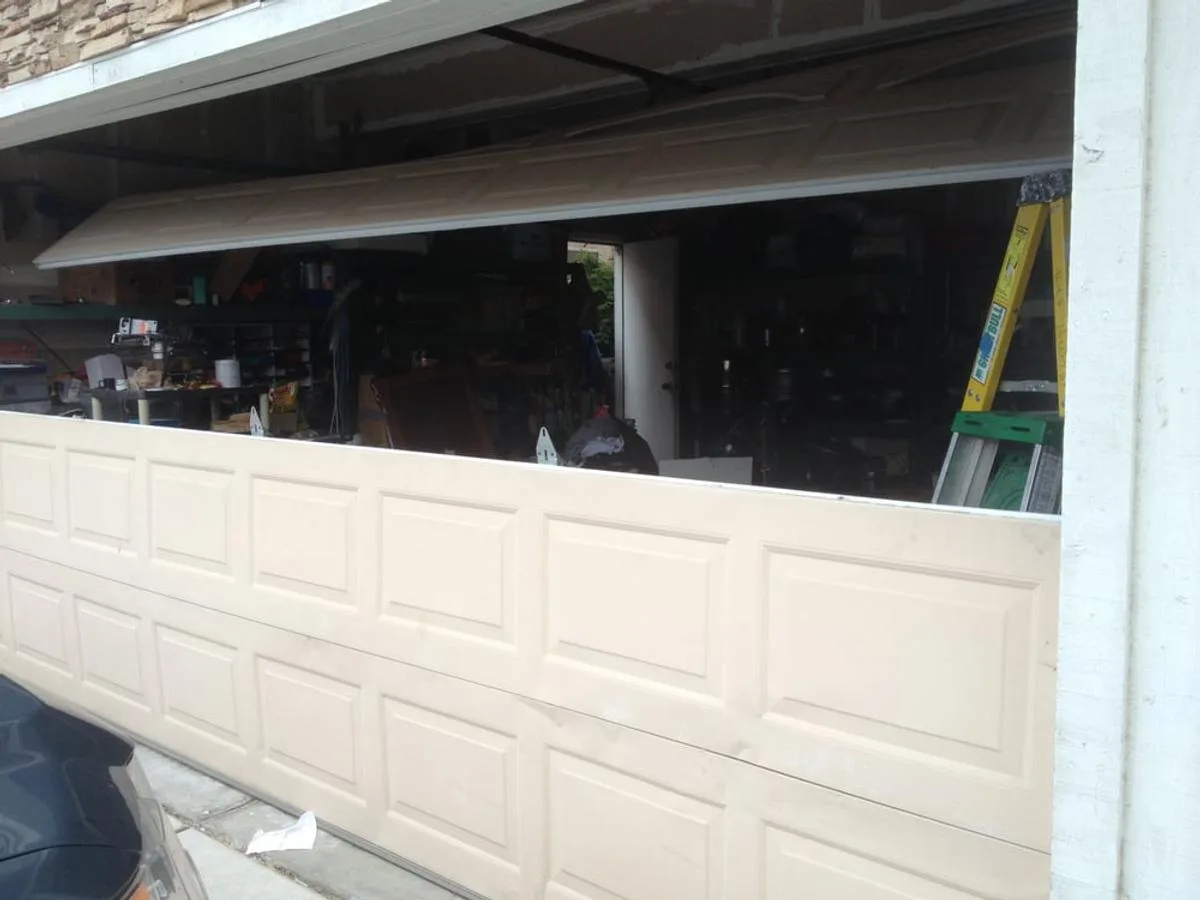
Factors That Affect Panel Replacement Cost in the Bay Area
Beyond the panel material, several Bay Area-specific factors influence the total cost of a garage door section replacement. Understanding these variables helps you budget accurately and avoid surprises on your final invoice.
Door Size
Panels for a standard single-car door (8 or 9 feet wide) are smaller and cheaper than panels for a two-car door (16 feet wide). A 16-foot panel can cost 40 to 60 percent more than an 8-foot panel of the same style simply because of the additional material.
Panel Position
The bottom panel is the most expensive to replace because it involves extra labor. The bottom panel connects to the lift cables, bottom brackets, and weatherseal. Removing and reinstalling these components adds 30 to 60 minutes of labor time compared to a middle or top panel. Top panels with torsion spring hardware attached are also slightly more complex.
Brand and Model Availability
If your garage door is from a major manufacturer (Clopay, Amarr, CHI, Wayne Dalton) and the model is still in production, replacement panels are readily available at standard pricing. If the model has been discontinued, you may need to source aftermarket panels or have a custom panel fabricated, which can add $100 to $400 to the cost. Doors from lesser-known brands or imported doors can be especially difficult to match.
Additional Repairs Needed
A damaged panel does not always exist in isolation. A vehicle impact that buckles a panel can also bend the tracks, snap rollers, or damage hinges. If the garage door repair involves straightening tracks, replacing rollers, or installing new hinges alongside the panel, expect to add $75 to $250 in additional parts and labor. We always inspect the entire door system during a panel replacement to catch any hidden damage.
Spring Adjustment
A new panel may have a slightly different weight than the old one, especially if you are upgrading from a non-insulated to an insulated panel. This means the torsion or extension springs may need to be adjusted to properly counterbalance the door. Spring adjustment is typically included in professional panel replacement, but if the springs are worn and need replacing at the same time, that is a separate cost of $200 to $400.
Color Matching Challenges with Older Doors
One of the most common cost surprises in the Bay Area is the color matching issue. If your garage door is more than five years old, the existing panels will have faded from UV exposure, and a new factory-fresh panel will look visibly different. In neighborhoods with strong sun exposure — like Pleasanton, Livermore, and Dublin in the Tri-Valley — fading happens faster. If color matching matters to you, budget an additional $200 to $500 for repainting the entire door face after the panel is installed. This is especially relevant for HOA-governed communities where visible mismatched panels may trigger compliance notices.
Discontinued Panels and Custom Fabrication
The Bay Area has a mix of home ages, from Victorian-era buildings in San Francisco to new construction in Dublin and Mountain View. Many homes built in the 1990s and 2000s have garage doors from manufacturers or model lines that no longer exist. When a panel is discontinued, you have three options: source an aftermarket compatible panel ($100 to $300 premium), have a custom panel fabricated ($300 to $600 premium), or replace the entire door. We maintain relationships with aftermarket suppliers across Northern California and can often find compatible panels that other companies cannot.
Bay Area Labor Market
Labor costs in the San Francisco Bay Area are higher than national averages due to the cost of living, licensing requirements, and insurance costs. You should expect to pay $150 to $300 for professional panel installation. Be cautious of quotes significantly below this range — unlicensed or uninsured contractors expose you to liability if something goes wrong. Always verify your technician holds a valid California Contractors State License Board (CSLB) credential. Integrity Garage Doors & Gates is fully licensed and insured — learn about our credentials.
When to Replace vs. Repair a Garage Door Panel
Not every damaged panel needs to be replaced. Understanding the difference between cosmetic damage and structural damage can save you hundreds of dollars. Here is a practical severity guide to help you determine whether your panel needs repair or replacement.
Cosmetic Damage (Repair Usually Sufficient)
Cosmetic damage affects the appearance of the panel but does not compromise its structural integrity or the door's ability to function properly. Common examples include:
- Shallow dents under one inch deep: These can typically be popped out from behind using specialized tools without removing the panel. Cost is usually $75 to $200.
- Surface scratches and paint chips: Sand the area, apply a rust-inhibiting primer, and repaint. A touch-up kit from the manufacturer costs $15 to $40.
- Minor surface rust: If the rust has not eaten through the steel, sanding and repainting will stop the corrosion. This is common on doors in San Francisco and Daly City where coastal fog accelerates oxidation.
- Faded or discolored paint: The entire door can be repainted for $200 to $500 rather than replacing panels for color mismatch.
Structural Damage (Replacement Required)
Structural damage affects the panel's ability to function as part of the door system. When structural integrity is compromised, repair is not enough — the panel must be replaced. Signs of structural damage include:
- Horizontal creases or buckles: A crease that runs across the panel means the steel has permanently deformed. The panel will never sit flat again, creating gaps in the weatherseal and stress points that worsen over time.
- Cracks that penetrate through the panel: Any crack that goes all the way through the panel material (not just the paint) means water, pests, and air can enter. On wood panels, through-cracks weaken the section enough that it could split apart under spring tension.
- Rust holes: Once rust has eaten completely through the steel, the only fix is replacement. Patching a rust hole is a temporary solution that fails within months.
- Warped or bowed panels: If the panel no longer sits flush with the adjacent sections when the door is closed, the rollers are binding and the door seal is compromised. This typically happens after a vehicle impact or severe temperature warping on wood panels.
- Broken hinge mounting points: If the area around the hinge holes is cracked or torn, the panel cannot securely hold the hardware. The door will bind and could go off track.
- Impact damage to the bottom panel: The bottom panel takes the most abuse and connects to the lift cables. A severely dented or bent bottom panel affects the entire door's operation and should be replaced promptly.
Dent Severity Guide
Use this quick guide to assess dent damage on your garage door panels:
- Minor (under 1 inch deep, no crease): Cosmetic only. Can be repaired in place. Door operates normally.
- Moderate (1 to 2 inches deep, slight crease): Borderline. May be repairable if no cracking, but the panel will show evidence of the repair. Get a professional assessment.
- Severe (over 2 inches deep, sharp crease or buckle): Replacement required. The steel is permanently deformed and the section is structurally weakened. This level of damage usually affects the weatherseal and roller alignment.
- Critical (panel bent out of track, visible gaps): Immediate replacement needed. The door may be unsafe to operate. Call for emergency garage door service if the door is stuck open or cannot be secured.
Can You Replace Just One Garage Door Panel?
Yes, in most cases you can replace a single garage door panel without replacing the entire door. This is one of the most cost-effective garage door repairs available. However, there are important considerations that affect whether a single panel replacement is the right choice for your situation.
When Single Panel Replacement Works Well
Single panel replacement is ideal when the rest of the door is in good condition and a matching panel is available. If your door is from a major manufacturer like Clopay, Amarr, CHI, or Wayne Dalton and the model is still in production, ordering an exact replacement panel is straightforward. Lead times are usually 3 to 10 business days, and the installation takes one to two hours. Homeowners in Oakland, Berkeley, and San Leandro frequently choose this option after minor vehicle impacts or storm damage to a single section.
The Color Matching Challenge
The biggest issue with replacing a single panel is color matching. Even if you order the exact same color code from the manufacturer, the new panel will look noticeably different from your existing panels because:
- UV fading: Your existing panels have been exposed to years of sunlight, which gradually fades the paint. A factory-fresh panel will be brighter and more saturated.
- Oxidation and weathering: Bay Area weather — fog, rain, and sun cycles — creates a patina on painted surfaces that a new panel will not have.
- Manufacturer color drift: Paint formulations can shift slightly between production batches, especially if the panel is ordered years after the original door was manufactured.
The good news is that this color difference typically blends within two to four months of sun exposure as the new panel weathers to match. For an immediate match, you can have the entire door repainted after installation for $200 to $500 — still cheaper than a full door replacement. Doors that face south or west in cities like Concord and Walnut Creek — where summer temperatures regularly exceed 90 degrees — tend to fade the new panel faster, which actually helps it blend sooner.
When Full Replacement Makes More Sense
Sometimes replacing the entire door is the smarter long-term investment, even if only one panel is damaged. Consider a full garage door installation instead of a single panel replacement when:
- The door model has been discontinued and no matching panels are available (common with doors over 12 to 15 years old)
- The single panel replacement cost exceeds 40 to 50 percent of a new door price
- Multiple panels show signs of aging, rust, or wear — replacing one will make the others look worse by comparison
- You want to upgrade from non-insulated to insulated panels (mixing insulation levels on the same door creates balance issues)
- The door style is outdated and you are planning to sell your home — a new door delivers one of the highest ROIs of any home improvement project, boosting curb appeal and home value
Single Panel Replacement vs. Full Garage Door Replacement
This is the question we get asked most often: should I replace a single garage door panel or just get a whole new door? Here is how to decide.
When to Replace Just the Panel
- Only one panel is damaged (the rest of the door is in good condition)
- The door is less than 15 years old
- Matching replacement panels are still available from the manufacturer
- The tracks, springs, and opener are working properly
- The panel replacement cost is less than 40 to 50 percent of a new door
- You are satisfied with the current door style and insulation level
When to Replace the Entire Door
- Two or more panels are damaged
- The door is 15 to 20+ years old with overall wear (faded paint, rust, drafty seals)
- The manufacturer has discontinued your door model and no matching panels exist
- The impact damaged structural components like tracks, the torsion shaft, or the header bracket
- You want to upgrade insulation, style, or add smart features anyway
- The cost of multiple panel replacements exceeds 50 percent of a new garage door installation
Cost Comparison
To put it in perspective: a single panel replacement costs $250 to $1,200, while a complete garage door replacement costs $1,200 to $4,500+ installed for a standard residential door. If you need two panels replaced at $500 each ($1,000 total) and a new door would cost $2,000, you are at the 50 percent threshold where a new door starts to make more sense — especially considering you get a full warranty, matching panels, new weatherseals, and potentially better insulation.
We always present both options with transparent pricing so you can make an informed decision. That is the Integrity difference — we recommend what actually makes sense for your situation, not what generates the biggest invoice. Contact us for a free estimate and we will lay out your options.
Signs You Need Garage Door Panel Replacement
Not sure if your panel damage warrants replacement? Here are the clear signs that a garage door section replacement is needed rather than just a cosmetic touch-up:
Visible Cracks or Splits
Cracks that go through the panel (not just the paint) compromise structural integrity. This is especially common on wood and fiberglass panels exposed to temperature swings. Once a panel cracks through, it weakens the entire door section and can allow water, pests, and cold air into your garage.
Deep Dents or Buckles
Shallow surface dents (less than half an inch deep) are usually cosmetic and can sometimes be repaired without panel replacement. Deep dents or buckles that distort the panel shape can prevent the door from sealing properly, cause the rollers to bind in the tracks, or create stress points that lead to further cracking. If the panel is buckled enough that it no longer sits flat when the door is closed, replacement is the right call.
Rust Holes or Corrosion
Surface rust can be sanded and repainted. But once rust eats through the steel and creates holes, the panel needs to be replaced. Rust holes let moisture into the panel's interior (and into your garage), and they only grow larger over time. This is a common issue we see on older doors in San Francisco and other fog-belt cities where moisture exposure is constant.
The Panel Is Off Track or Misaligned
If a panel has shifted so that it no longer aligns with the panels above and below it, or if you can see daylight through gaps between sections, the panel may be warped or the hinge points may be damaged beyond repair. A door that goes off track repeatedly often has a damaged panel at the root of the problem.
The Door Will Not Seal When Closed
A warped or buckled panel creates gaps that compromise your garage's weatherseal. If you can feel drafts around a specific section of the door, or if you notice water getting in during rain, the panel in that area likely needs replacement.
Garage Door Panel Dent Repair vs. Replacement
Before committing to a full panel replacement, it is worth considering whether garage door panel dent repair might solve the problem. Here is how to decide:
When Dent Repair Works
- The dent is shallow (less than one inch deep) and the panel surface is not cracked
- The dent is in a flat section of the panel, not on a raised ridge or seam
- The panel is steel (aluminum dents are harder to repair without leaving marks)
- The paint is still intact around the dent area
Minor dent repair typically costs $75 to $200 and involves using specialized tools to push the dent back into shape from behind the panel, then touching up the paint. This is significantly cheaper than a full panel replacement and can restore the door's appearance for cosmetic dents.
When Replacement Is Necessary
- The dent is deep enough to crease or crack the steel
- Multiple dents are clustered on the same panel
- The dent has caused the panel to warp or bow
- The impact damaged the panel's insulation core
- The panel is fiberglass or wood (these materials do not bounce back like steel)
How to Measure Your Garage Door Panels for Replacement
If you want to get an accurate quote or check panel availability before calling a technician, here is how to measure your garage door panels correctly:
Step 1: Measure the Door Width
Measure the total width of the garage door opening from one side of the frame to the other. Standard widths are 8 feet (96 inches) for a single-car door, 9 feet (108 inches) for a wide single, and 16 feet (192 inches) for a two-car door. The panel width will match this measurement.
Step 2: Measure the Panel Height
Measure the height of the individual panel section from the top hinge line to the bottom hinge line. Most residential panels are 18 to 24 inches tall. Do not measure the total door height — you need the height of the single section that needs replacing.
Step 3: Measure the Panel Thickness
Use a ruler or tape measure on the edge of the panel to check the thickness. Non-insulated steel panels are typically 1 to 1.5 inches thick. Insulated panels range from 1.375 to 2 inches. This measurement helps determine the R-value and whether the replacement needs insulation.
Step 4: Note the Panel Profile and Style
Identify the panel design: raised panel, recessed panel, flush (flat), long panel, or carriage house style. Take a close-up photo of the panel face and any decorative elements. Also note whether the panel has window inserts.
Step 5: Find the Manufacturer and Model
Look for a sticker or label on the inside of the top panel or on the vertical track. It will list the manufacturer, model number, and sometimes the date of manufacture. If there is no label, take photos of the hardware pattern (hinge placement, roller bracket style) — a professional can often identify the door from these details. Share this information when you request your free estimate.
Matching a Replacement Panel to Your Existing Door
Finding an exact match is the most critical part of any garage door panel replacement job. A mismatched panel sticks out visually and can even cause operational problems if the dimensions are off. Here is how we approach matching:
- Identify the manufacturer and model. Using the label, hardware pattern, and panel profile, we determine the exact door you have. Our technicians have worked with every major brand in the Bay Area and can often identify a door on sight.
- Check current production status. We contact the manufacturer or distributor to confirm the panel is still available. Major brands like Clopay, Amarr, and CHI keep popular models in production for 10 to 15 years. Wayne Dalton and Raynor also maintain good parts availability.
- Order in the correct color. We order the panel in your door's original color code. A factory-fresh panel will look slightly different from your sun-faded existing panels. This color difference typically blends within two to three months of UV exposure.
- Explore alternatives if needed. If the exact panel is discontinued, we check aftermarket suppliers that make compatible replacement sections. In some cases, we can paint or stain a close-match panel to blend with the existing door. If nothing works, it may be time for a full door replacement.
The Garage Door Panel Replacement Process
Here is exactly what happens when our technicians replace a garage door panel at your Hayward home or anywhere in the Bay Area:
- Inspection and confirmation. We inspect the damage in person, confirm the replacement panel is the correct match, and check the surrounding hardware for any hidden damage.
- Secure the door. We clamp the door in place and disconnect the opener to prevent any movement during the repair. Safety is the top priority — a garage door under spring tension can be dangerous if it moves unexpectedly.
- Remove the damaged panel. We detach the hinges, rollers, and brackets from the damaged panel and carefully slide it out of the track. Bottom panels require disconnecting the lift cables and bottom brackets, which adds time and complexity.
- Install the new panel. The replacement panel slides into position between the adjacent sections. We reattach all hardware, ensuring the hinges are tight and the rollers are properly seated in the tracks.
- Adjust spring tension. If the new panel has a different weight than the old one, we adjust the torsion or extension springs to maintain proper door balance. An unbalanced door strains the opener and wears out springs faster.
- Test the door. We reconnect the opener and run the door through multiple open-close cycles to verify smooth operation, proper seal, and correct opener force settings.
- Weatherseal inspection. We check and replace the bottom weatherseal and side seals if they were damaged along with the panel.
The entire process takes one to two hours for a single panel. If additional repairs are needed (track straightening, roller replacement), allow two to three hours.
DIY vs. Professional Garage Door Panel Replacement
Can you replace a single garage door panel yourself to save on labor costs? Technically, yes — but there are serious reasons most homeowners should hire a professional.
Why DIY Panel Replacement Is Risky
- Spring tension is dangerous. The door must be secured while you work. Torsion springs hold hundreds of pounds of force, and if the door shifts while you are removing a panel, the consequences can be severe. Garage door safety is not something to take lightly.
- Alignment is critical. If the new panel is not perfectly aligned with the adjacent sections, the door will bind, the rollers will wear unevenly, and the weatherseal will not close properly.
- Bottom panels are especially complex. Disconnecting and reconnecting lift cables and bottom brackets requires specific knowledge. An incorrect cable routing can cause the door to go off track.
- Weight matters. A 16-foot insulated panel can weigh 75 to 100 pounds. Handling it safely while positioning it in the track requires at least two people and the right lifting technique.
- Spring adjustment. If the new panel changes the door weight, the springs need rebalancing. This is not a DIY job — adjusting torsion springs without proper tools and training is the leading cause of garage door injuries.
What You Save (and What You Risk)
Professional labor for panel replacement runs $150 to $300. If you attempt the job yourself and the door goes off track, binds, or you damage the new panel during installation, you could end up paying more than if you had hired a professional from the start. Worse, an improperly installed panel can be a safety hazard for your family.
Our Recommendation
Unless you have specific experience with garage door mechanics, hire a licensed technician. The labor cost is modest relative to the panel cost, and you get the peace of mind that the job was done safely and correctly. Call (888) 485-6995 for same-day garage door repair service anywhere in the Bay Area.
Does Insurance Cover Garage Door Panel Replacement?
If the panel damage was caused by a covered event — a vehicle backing into the door, storm damage, fallen tree limb, or vandalism — your homeowner's insurance may cover the garage door panel replacement cost. Here is how it typically works:
- File a claim with your insurance company and get a claim number before any work begins.
- Get a written estimate. We provide a detailed line-item estimate that your adjuster can review, including the panel cost, labor, and any additional parts.
- Check your deductible. Most homeowner's policies have a $500 to $1,000 deductible. If the repair costs less than your deductible, filing a claim may not be worthwhile — and a small claim can affect your premiums.
- Vehicle impact note: If you hit your own garage door with your car, the damage is typically covered under your auto insurance (collision coverage), not your homeowner's insurance. If someone else hit your door, their auto liability insurance should cover it.
We work with insurance adjusters regularly across the Bay Area and can provide all the documentation they need to process your claim. We have handled hundreds of insurance panel replacements in cities from San Francisco to San Jose.
Need a garage door panel replaced? Send us a photo of the damage and we can often give you a preliminary quote over the phone. Call (888) 485-6995 or request a free estimate online. We handle panel replacements across the entire Bay Area with same-day service available. Our technicians are based in Hayward and serve every city from San Francisco to San Jose, Walnut Creek to Fremont, and everywhere in between.
Frequently Asked Questions About Garage Door Panel Replacement
How much does it cost to replace one garage door panel?
In the Bay Area, a single garage door panel replacement cost ranges from $250 to $1,200 including parts and professional labor. Standard steel panels run $250 to $500 installed, insulated steel panels $350 to $700, aluminum panels $300 to $600, and solid wood panels $500 to $1,200. The exact price depends on the door brand, panel material, size, insulation level, and whether the model is still in production.
Can you replace just one panel on a garage door?
Yes, in most cases you can replace a single garage door panel without replacing the entire door. The key requirement is that the replacement panel must match your existing door in style, color, and dimensions. If your door model is still in production, the manufacturer can supply an exact match. If it has been discontinued, aftermarket options may be available, or a full door replacement may be necessary.
Is it cheaper to replace one panel or the whole garage door?
A single panel replacement ($250 to $1,200) is almost always cheaper than a full garage door replacement ($1,200 to $4,500+ installed). The rule of thumb is that if the panel replacement costs less than 50 percent of a new door, and the rest of the door is in good condition, replacing just the panel is the better financial decision.
Can I replace a garage door panel myself?
DIY garage door panel replacement is not recommended for most homeowners. The job requires disconnecting the opener, securing the door under spring tension, handling heavy panels (75 to 100 pounds for a 16-foot section), and potentially adjusting spring tension afterward. An improperly installed panel can cause the door to bind, go off track, or create a safety hazard. Professional labor adds only $150 to $300 to the total cost.
Will a replacement panel match my existing garage door?
If your door model is current and the new panel comes from the same manufacturer, it will match in style and dimensions. The color may differ slightly because your existing panels have faded from UV exposure while the new panel is factory fresh. This difference typically blends within two to three months of sun exposure. For an immediate match, the entire door can be repainted after installation.
How do I measure my garage door panel for replacement?
Measure the total door width (typically 8, 9, or 16 feet), the individual panel height from hinge to hinge (usually 18 to 24 inches), and the panel thickness (1 to 2 inches). Note the panel profile style and check for a manufacturer label on the inside of the top panel or vertical track. Take photos and share them when you request your free estimate.
How long does it take to replace a garage door panel?
The actual installation takes one to two hours once the replacement panel is on site. The lead time for ordering the panel is typically 3 to 10 business days depending on the manufacturer and stock availability. Common models from Clopay, Amarr, and CHI are often available within a week.
Does homeowner's insurance cover garage door panel damage?
If the damage was caused by a covered event such as storm damage, a fallen tree, or vandalism, your homeowner's insurance may cover it. Vehicle impact to your own garage door is typically covered under your auto insurance (collision coverage). Most policies have a $500 to $1,000 deductible, so minor repairs may not be worth a claim.
How much does it cost to replace a garage door panel on a two-car door?
A replacement panel for a 16-foot (two-car) garage door costs roughly 40 to 60 percent more than a single-car (8 or 9-foot) panel. Expect to pay $400 to $800 for a standard steel panel installed, $500 to $1,000 for an insulated steel panel, or $700 to $1,500 for a wood panel on a two-car door. The larger size means more material, heavier weight (requiring more labor to handle safely), and higher shipping costs from the manufacturer. Many homeowners in San Ramon, Danville, and Pleasanton have two-car or three-car garages, so this is a common question in the Tri-Valley area.
Can I get a discount on garage door panel replacement?
Yes. Many garage door companies, including Integrity Garage Doors & Gates, offer seasonal promotions and multi-service discounts. If you need panel replacement along with other work — spring adjustment, roller replacement, or weatherseal installation — bundling services often reduces the total cost. We also provide free estimates with no service call fee, so you know exactly what you will pay before we start. Senior and military discounts may also be available depending on the service provider.
What is the cheapest way to fix a damaged garage door panel?
The cheapest option depends on the type and severity of damage. For minor dents (under one inch deep), professional dent repair costs $75 to $200 without replacing the panel. For surface rust, sanding and repainting runs $50 to $150. If the panel needs actual replacement, a standard non-insulated steel panel is the most affordable option at $300 to $650 installed. Avoid the temptation to leave structural damage unrepaired — a warped or cracked panel puts additional stress on the springs, rollers, and opener, which can lead to more expensive repairs down the road.
Related Articles
Serving the Entire Bay Area
Integrity Garage Doors & Gates provides expert service across the San Francisco Bay Area. Find your local service area:
Hayward • Oakland • Fremont • San Jose • San Francisco • Concord • Walnut Creek • Dublin • Pleasanton • Castro Valley • San Leandro • Danville • San Ramon • Palo Alto • Mountain View • Berkeley • San Mateo • Redwood City • Livermore • All Locations →
Damaged Garage Door Panel?
Whether you need one panel replaced or a whole new door, we will give you honest advice and a firm quote. Same-day service available throughout the Bay Area.